
There was a time when running a Facebook or Instagram ad meant picking an audience, choosing some interests, setting a budget, and hoping the algorithm did its thing.
Remember that?
It feels a little like asking your parents to drive you somewhere before GPS existed.
“Just head toward the mall. You’ll know it when you see it.”
Meta advertising has changed quite a bit since then.
And one of the more interesting changes happening now is not really about targeting.
It is about identity.
More specifically, it is about Meta learning who your audiences are in relation to your business.
The audience is becoming part of your business identity
A recent LeadGenius article makes a larger argument about where advertising technology is heading.
The company describes an “audience layer” developing underneath traditional media buying. The idea is that the real strategic asset isn’t simply where you buy advertising. It is the data and logic that define who your customers are, why they matter, and how those audiences connect to revenue.
That is a pretty significant shift.
For years, advertisers have essentially told platforms:
“Here is some money. Find me people interested in this.”
Now the conversation is becoming more like:
“Here is what my business knows about its customers. Use that information to understand the people who matter to me.”
That is a very different relationship.
Meta is starting to give that relationship a structure
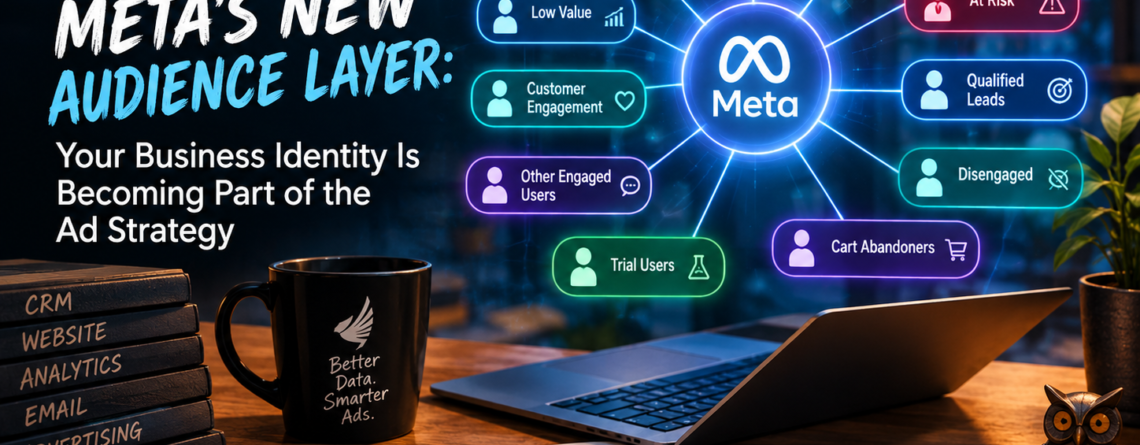
Meta has been rolling out a redesigned Audiences section built around audience labels.
According to Metalla’s August 2026 analysis, eligible Custom Audiences can now be organized into categories such as Customers and Engaged Audiences, with labels including:
- High Value
- Low Value
- Recent Purchasers
- At Risk
- Disengaged
- General Customers
- Qualified Leads
- Disqualified Leads
- Trial Users
- Cart Abandoners
- Other Engaged Users
Lookalike and Saved Audiences remain separate from this labeling system.
On the surface, this might look like Meta simply cleaned up the Audiences screen.
I don’t think that is the interesting part.
The interesting part is what Meta can do with the information behind those labels.
Meta doesn’t know your customers the way you do
Let’s say you own a law firm.
Meta might know that someone visited your website.
It might know that they watched a video.
It might know that they submitted a lead form.
It might know that they interacted with your Facebook or Instagram content.
But your CRM may know something much more useful.
Maybe that person:
- Actually qualified for your service
- Was outside your service area
- Had a case worth pursuing
- Became a client
- Never answered the phone
- Was rejected by the firm
- Generated $25,000 in revenue
- Generated $2,000 in revenue
- Was a great client who referred three more people
Those are very different people.
Yet if the only signal going back to Meta is “Lead,” they can look surprisingly similar from the advertising platform’s perspective.
That is where audience identity becomes important.
Your CRM can tell Meta what “good” actually means
Metalla’s analysis describes audience labels as a way to give Meta additional first-party business context.
For example, a business can distinguish between qualified and disqualified leads or between higher-value and lower-value customers. Those labels can then work with Meta’s audience value rules to influence how aggressively Meta bids for those groups.
Think about the difference.
Old-school advertising:
“Find people who look like my customers.”
Newer advertising:
“Here are the people who actually became valuable customers. Here are the people who didn’t. Now use that information when deciding where my advertising dollars should go.”
That is a much richer signal.
This is where the “corporate identity layer” gets interesting
I use the phrase corporate identity layer because I think it describes something larger than an advertising audience.
Your company already has an internal understanding of its customers.
Your CRM has it.
Your sales team has it.
Your accounting system has it.
Your website has pieces of it.
Your email platform has pieces of it.
Your analytics has pieces of it.
Your customer service team has pieces of it.
The problem is that those pieces traditionally live in separate systems.
Advertising platforms then receive a simplified version.
Someone clicked.
Someone visited.
Someone submitted a form.
Someone purchased.
But the company itself knows much more.
The emerging audience layer is about taking some of that business knowledge and making it usable across advertising systems.
LeadGenius makes a similar argument at the broader ad-tech level: the audience definition, identity layer, activation and measurement are becoming more strategically important than simply buying impressions.
That’s a big deal for businesses.
Because your audience isn’t just a collection of people.
It is a representation of your business.
And this is why first-party data matters
There is another important piece here.
Your customer data is yours.
At least, it is data your business directly collects and manages within the applicable privacy and data-use rules.
Meta’s Customer List Custom Audiences terms, for example, require advertisers to have the appropriate rights, permissions and lawful basis to provide customer information for audience matching. Meta also states that the uploaded hashed data is used for matching and that advertisers don’t receive the identities of individual people who make up the resulting audience.
That distinction matters.
The goal isn’t to dump every piece of customer information into Meta.
The goal is to send the right signals, in the right way, for the right purpose.
Good data in.
Useful signals out.
Don’t confuse audience labels with a magic “buy button”
There is also an important limitation here.
Adding a label doesn’t magically make an advertising campaign better.
Metalla points out that labels themselves don’t change delivery. The impact comes when the information is used through eligible features such as value rules or other campaign settings.
That means slapping “High Value” on 14 different audiences because it sounds good isn’t a strategy.
You need a definition.
What does “high value” actually mean?
Maybe it’s:
$10,000+ in annual revenue.
Maybe it’s a customer who buys four times a year.
Maybe it’s a qualified B2B lead that reaches a particular sales stage.
Maybe it’s a client with a 70% retention rate.
The label needs to represent something measurable.
Otherwise, you’re just putting a name tag on a bucket.
And I’ve seen enough corporate meetings to know that putting a name tag on a bucket does not magically turn it into a strategy.
Meta is moving toward broader targeting. This fits.
There is an interesting tension here.
Meta has been moving advertisers toward broader targeting and greater automation through tools such as Advantage+ Audience.
At first, that sounds like the opposite of detailed audience segmentation.
It isn’t necessarily.
The shift is from manually telling Meta exactly who to target toward giving Meta better information about the people who matter.
Metalla describes audience labels as a way to feed business context into Meta’s increasingly automated systems rather than rebuilding old-fashioned manual targeting inside a new interface.
That’s an important distinction.
You aren’t necessarily saying:
“Only show my ad to these 17,000 people.”
You may instead be saying:
“These are the kinds of customers that have proven valuable to my business. Understand that distinction.”
Then let the machine do what machines are good at.
The real opportunity isn’t inside Meta
This is the part I find most interesting.
The audience layer shouldn’t start inside Ads Manager.
It should start inside the business.
Before you ever create a Meta audience, you should be able to answer:
Who is our customer?
Who becomes a good customer?
Who becomes a bad customer?
What makes a lead qualified?
What makes a lead worthless?
Which customers generate the most revenue?
Which customers stay the longest?
Which customers buy again?
Which prospects are actually moving toward a sale?
Those answers create your business’s audience intelligence.
Then you can decide what information should flow into Meta.
That’s a much stronger foundation than starting with a dropdown menu inside an advertising platform.
The future may be “bring your own audience”
LeadGenius puts the broader trend pretty bluntly: the future of advertising may be less about letting individual platforms define your audience and more about bringing your own audience intelligence to those platforms.
I think that idea deserves some attention.
Your audience shouldn’t belong to Facebook.
It shouldn’t belong to Google.
It shouldn’t belong to LinkedIn.
Those platforms are distribution channels.
Your customer knowledge is part of your business.
That distinction becomes even more important as AI takes over more of the mechanical work involved in advertising.
If AI is going to decide where your money goes, the quality of the information you give it becomes incredibly important.
Garbage data in.
Very expensive garbage data out.
That’s still how computers work.
Even if we put “AI” on the box.
What should businesses be doing now?
You don’t need to rebuild your entire marketing stack tomorrow.
Start with the basics.
Audit your existing customer and lead data.
Create clear definitions for:
- Customer
- Qualified Lead
- Disqualified Lead
- High-Value Customer
- Recent Customer
- At-Risk Customer
- Engaged Prospect
Then connect those definitions to actual business data.
Your CRM should know what happened to the lead after the form submission.
Your analytics should know what happened before and after the conversion.
Your advertising platform should receive meaningful signals rather than simply being told that somebody filled out a form.
And your reporting should ultimately connect advertising activity to actual business results.
That’s where this gets bigger than Facebook ads.
Your website is part of the identity layer too
This is also why your website, CRM, analytics, email marketing, SEO and advertising should not operate like five unrelated departments that occasionally bump into each other in the hallway.
Your website creates signals.
Your SEO attracts people.
Your content creates engagement.
Your forms create leads.
Your CRM tracks relationships.
Your sales team determines qualification.
Your accounting system records revenue.
Your advertising platforms can then learn from the outcome.
That’s the ecosystem.
The ad isn’t the strategy.
The audience isn’t just a targeting setting.
The audience is a representation of the business.
And that may be one of the more important changes happening in digital marketing right now.
The Owl’s take
I’ve spent a lot of years watching digital marketing go through its various “this changes everything” moments.
Some did.
Some were basically the marketing equivalent of New Coke.
This one is worth watching.
Meta’s audience-label changes are relatively small on the surface, but they point toward a much larger shift in advertising: businesses are getting more control over how their first-party customer knowledge is represented inside automated advertising systems.
The real question isn’t:
“Can Meta find my audience?”
The better question is:
“Does my business actually understand its audience well enough to teach Meta what matters?”
Because if your CRM, website, analytics and advertising platforms all have different versions of your customer, you’ve got an identity problem before you’ve got an advertising problem.
And that is something worth fixing.
After all, the algorithm can only be as smart as the information we give it.
And if that information is coming from a spreadsheet named FINAL_FINAL_CUSTOMERS_v7.xlsx sitting on someone’s desktop…
Well…
We may have found the real problem.
Until next time,
Tony
The Owl
Imprinted Owl
P.S. If your marketing data feels like it needs its own detective board with red string connecting everything together, maybe you need an Owl watching the night shift. Check out the Imprinted Owl shop. We have merch for marketers who have survived enough dashboards to deserve a T-shirt.


Leave a Reply