
A small database permission change can turn into a big headache if your application isn’t prepared.
If you build websites, web applications, or client portals using Supabase, there’s a change you need to understand.
Starting October 30, 2026, Supabase will stop automatically granting Data API access to new tables created in the public schema for existing projects.
Your existing tables aren’t affected. They’ll keep their current permissions and remain accessible through the Data API.
But any new table created in public will need explicit permissions before your application can access it through Supabase’s API.
That includes tables created through database migrations, preview branches, new projects, and local database resets.
Let’s break down what this means and what you should do about it.
What’s changing?
Supabase makes it easy to connect a database to your application through tools such as supabase-js, PostgREST, and GraphQL.
Historically, new tables in the public schema could receive automatic Data API access through default permissions.
That behavior is changing.
Starting October 30, new tables will require explicit SQL GRANT statements before the Data API can access them.
Without the necessary permissions, API requests will fail with a permission-denied error.
Your database table might exist. Your application code might be correct. Your connection might be working.
And your application can still fail because the database doesn’t have the required permissions.
Welcome to the wonderful world of database administration.
Why is Supabase making this change?
The goal is to give developers more control over which database tables their applications can access.
Automatic permissions are convenient, especially when you’re building a new application. But convenience can also create unintended exposure when developers create tables without considering how those tables should be accessed.
Explicit grants make access decisions more deliberate.
Instead of assuming every new table should be accessible through the API, developers must define which database roles can interact with each table.
That’s a useful security practice.
It also means your database migrations need to account for permissions, not just table structures.
What does this mean for your application?
Consider a common scenario.
You’re building a client portal with Supabase. Your application has a customers table, an invoices table, and a projects table.
Everything works as expected.
Next week, you create a new project_notes table to store internal notes and updates.
Your frontend attempts to retrieve those notes using supabase-js.
The request fails because the new table doesn’t have the required Data API permissions.
You troubleshoot your JavaScript, inspect your API configuration, and check your database connection.
But the problem isn’t your frontend code.
It’s the missing database grants.
This is the type of issue that can catch developers off guard, especially when a change works in one environment but fails in another.
How to prepare for October 30
Supabase recommends adding explicit grants in the same migration that creates each table.
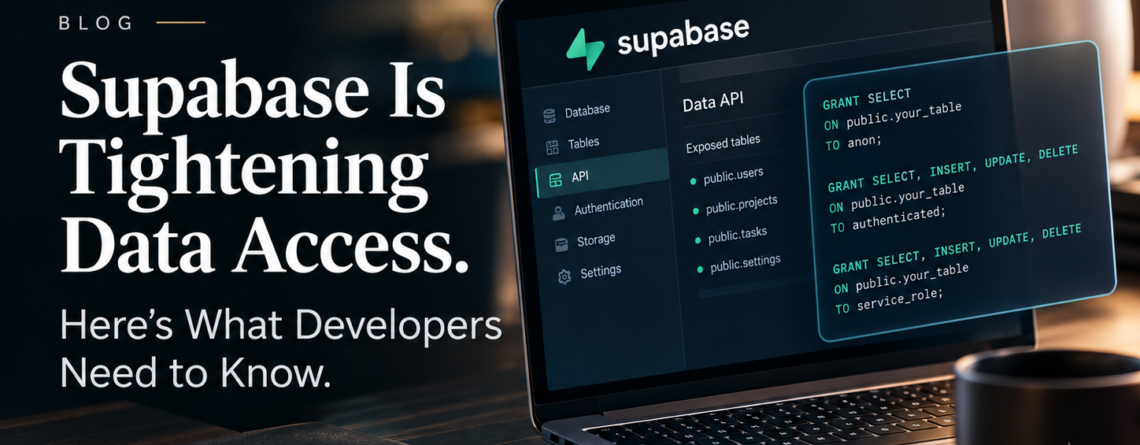
For example, here’s a basic permissions configuration:
GRANT SELECT
ON public.your_table
TO anon;

GRANT SELECT, INSERT, UPDATE, DELETE
ON public.your_table
TO authenticated;

GRANT SELECT, INSERT, UPDATE, DELETE
ON public.your_table
TO service_role;
Replace your_table with the actual table name.
These statements define which database roles can perform specific operations.
anongenerally represents requests made without an authenticated user session.authenticatedrepresents requests associated with authenticated users.service_roleis a privileged role commonly used for trusted server-side operations.
Don’t copy these grants blindly into production. They illustrate the mechanics of the change, not a universal security policy.
For example, a table containing private customer information may not need anonymous access. A user-facing table may also need row-level security (RLS) policies to restrict which records each authenticated user can access.
A table-level grant determines which operations a role may attempt. RLS policies can further restrict which rows that role can access.
Both layers matter.
Don’t forget migrations and development environments
One of the easiest mistakes is updating your production database while forgetting about the rest of your development workflow.
Supabase specifically calls out several scenarios that need attention:
- New database migrations that create tables.
- Preview branches used for testing.
- New projects.
- Local environments rebuilt with
supabase db reset. - Migrations that recreate database schemas.
If your migration creates a table but doesn’t define its required permissions, the application may behave differently across environments.
The fix is straightforward: include the appropriate grants in the migration that creates the table.
That keeps your schema and its access rules together, making the database easier to reproduce and maintain.
Audit your existing Supabase project
Before making changes, review your current configuration.
Here’s a practical checklist:
- Review your project’s Data API settings to identify exposed tables.
- Identify which tables need anonymous access and which require authentication.
- Check your existing database grants and RLS policies.
- Update migrations to include explicit permissions for newly created tables.
- Test migrations in a local or preview environment.
- Confirm that your application can read and write the expected data.
- Verify that unauthorized users cannot access protected records.
You can review the configuration in your Supabase Data API settings.
For the official announcement and technical details, see the Supabase discussion about the Data API exposure change.
The bigger lesson: convenience and security aren’t the same thing
This change is a good reminder that getting an application working is only one part of building it properly.
Your website or application can have clean code, a polished interface, and a reliable hosting environment while still having database permission problems.
Security depends on the details behind the interface.
That includes database grants, row-level security, API exposure, authentication, and how your development and production environments are configured.
For developers, this means treating permissions as part of the database design process rather than something to troubleshoot after an API request fails.
For business owners, it reinforces why ongoing application maintenance matters. Software updates and platform changes can affect how an application behaves, even when nobody has touched the frontend.
A little preparation now can prevent a frustrating debugging session later.
And if you’re managing multiple websites or applications, this is exactly the sort of change that deserves a place on your maintenance checklist.
A final word from Tony at Imprinted Owl
I’m all for making development easier. Nobody wants to spend their Friday afternoon chasing a permission error that turns out to be one missing SQL statement.
But convenience should never come at the expense of knowing who can access your data.
Check your Supabase projects, review your permissions, and make sure your migrations account for the change before October 30.
Your future self will thank you.
And if your database starts giving you the silent treatment, at least you’ll know where to look first.
Keep your digital presence in good shape.
The Owl is on watch.
Need Help Keeping Your Website and Applications Running Smoothly?
Keeping your digital presence secure, up to date, and working as expected takes more than launching a website and hoping for the best.
At Imprinted Owl, we help businesses manage the technical side of their digital presence, from website maintenance and security to troubleshooting, platform updates, and ongoing technical support.
Whether you need help maintaining an existing application, resolving a technical issue, or keeping your digital infrastructure in good shape, we’re here to help.
Let’s take a look at what you’re working with.
Contact Imprinted Owl to discuss your project and find out how we can help keep your digital presence working for your business.







Leave a Reply